Upcoming Events
September 2010
SunMonTueWedThuFriSat
  
 1 2 3 4
5 6 7 8 9 10 11
12 13 14 15 16 17 18
19 20 21 22 23 24 25
26 27 28 29 30  
See all events >>
Education Headlines

Brewer, Goddard spar over immigration, state budget

Thursday September 2nd

Republican Gov. Jan Brewer and Democratic challenger Terry Goddard attacked each other's ... LEARN MORE »

AZ Fact Check - Proposition 107

Thursday September 2nd

Proposition 107 would amend the Arizona Constitution to prohibit affirmative-action programs. If ... LEARN MORE »

School notes

Thursday September 2nd

Tucson, AZ:  Parents interested in building a better relationship with their children can ... LEARN MORE »

New education report card grades student success, Arizona lags behind

Wednesday September 1st

Today, the American Legislative Exchange Council (ALEC) released a new book that provides a ... LEARN MORE »

Judge to hear arguments on Arizona's efforts to help students learn English

Wednesday September 1st

A federal judge is hearing arguments this week over whether the state is complying with federal ... LEARN MORE »

[ view all ]
About the Blog:

Welcome to the Expect More Blog. You are a part of the movement to make education a top priority in Arizona. This is your movement and your blog; we encourage you to stay involved by posting comments and letting us know what you'd like to see here.

Thank you for joining us. Please share Expect More Arizona with all of your family and friends. Together, we will make Arizona a model for excellence in education.

Expect More Blog

11 Aug


Arizona’s students are falling behind their global peers in academic performance, high school graduation rates and postsecondary degree attainment. Career and technical education are a viable and proven pathway to success for many students, and our education system must better prepare all students for every academic and career opportunity that comes their way.

Career and technical education, or CTE for short – can be important to Arizona students and their futures. CTE programs, which at one time were known as vocational education courses, are created with industry input and guidance to ensure the curriculum matches the needs of business.  While learning their craft through hands-on projects, students learn real-life work skills and become familiar with these careers, enabling them to get a head start on their chosen professions while they are still in high school.

Employers will need skilled, trained and educated workers for the 21st century economy, and CTE and applied learning programs are key to preparing young people for the jobs of the future.  However, CTE does more than just train students for jobs; it provides an invaluable education that contributes to student and community success in both rural and metro Arizona.

“Studies predict that by 2012, 2/3 of all new jobs will require some level of college education or advanced vocational training – a steady stream of reports about the demands of current and future employers reinforces the need for a highly skilled, educated workforce,” said J. Doug Pruitt, President and CEO of Sundt Construction. “The ability to deliver the types of workers we need requires a strong, high quality education system – from birth through career –providing all students with meaningful, hands on learning opportunities which fully prepare them for postsecondary education, career and life.”

The advantages of CTE are many: participants learn more than one skill, score higher on average on the state’s AIMS test in critical subjects such as math, science and reading and are more likely to advance to and earn a two- or four-year postsecondary degree.  In the past year, more than two-thirds of those who completed CTE courses went on to community college, or were placed in jobs or entered the military. CTE students can work in their chosen fields after high school, earn a stable salary and gain experience while they are working toward an associate’s or bachelor’s degree in college.

Across Arizona, there are 1,670 CTE program courses offered in 72 occupational programs.  More than 104,000 students benefit from CTE programs statewide, thanks to federal and statewide grants, without which it would be difficult for school districts to fund CTE on their own.  With so many disciplines available for students to choose – from engineering to biotechnology to bioscience to automotive technology – the curricula are challenging and important, filling not only industry needs, but also providing opportunities for students to grow academically in core education subjects.

28 Jul
Moving Arizona Ahead Demands Degrees
By Dr. Rufus Glasper & Regent Fred DuVal, Co-Chairmen of “Getting AHEAD”

According to a prominent new study, Arizona is winning a race, not to the top but to the bottom: we are about to lead the nation in jobs for high school dropouts. To reverse this dangerous trend, the state must reshape its higher education system to attract, serve and graduate more college students.

The study by the Georgetown University Center on Education and the Workforce tells us that Arizonans are at-risk of being locked out of the middle class. It predicts that Arizona will have enough jobs for high school dropouts, but soon we will be woefully deficient in the number of college graduates needed to fill the high-wage, modern jobs that businesses demand.

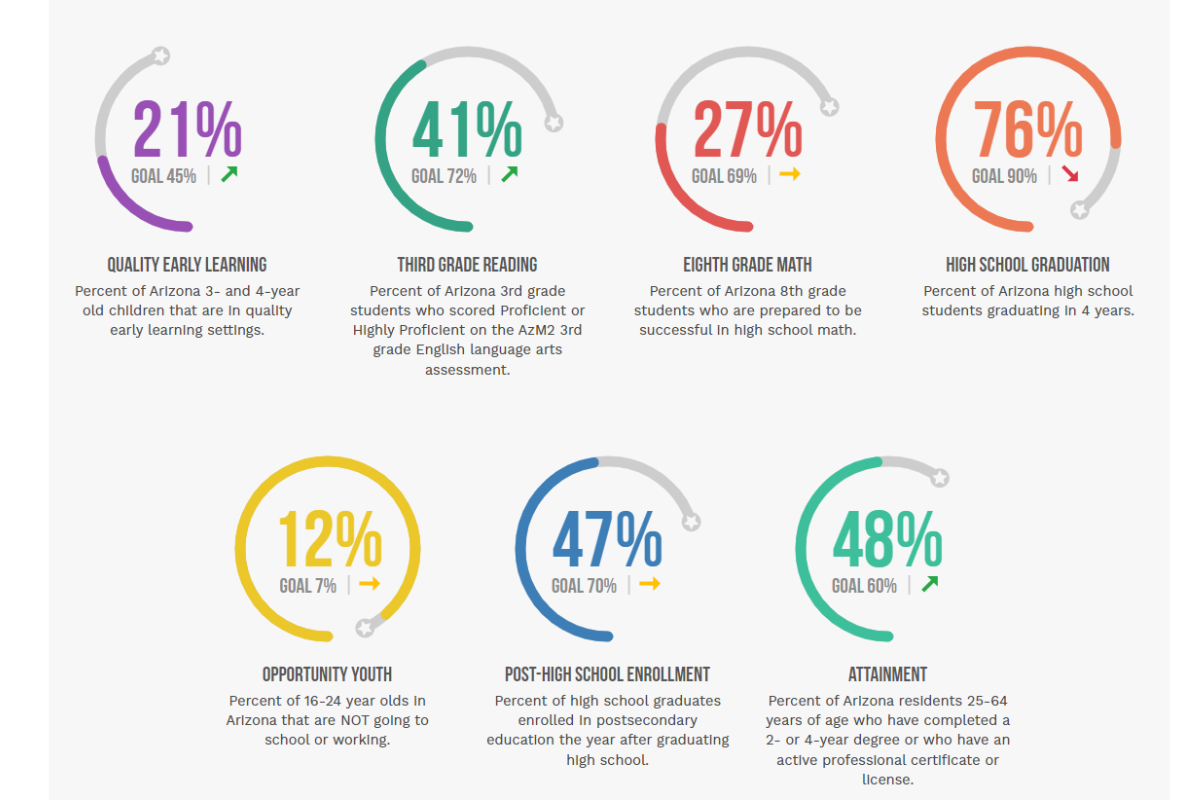
What may be most concerning about this report is that it speaks to a persistent mediocrity in our state. Already, 45 percent of Arizona’s high school students do not pursue any form of higher education after high school – the lowest rate among 50 states. Only 25 percent of Arizonans hold bachelor’s degrees.

While it may be easy to find a job in Arizona with just a high school diploma, the new middle class is being defined by college degree holders who are in a better position to sustain a family and grow their income.

Arizona’s residents can aspire to a higher quality of life and the state’s public higher education system is improving how it helps students achieve that dream.

Under way right now is a collaborative effort called “Getting AHEAD – Access to Higher Education And Degrees,” which will improve access to higher education for students across the state.  We are developing new and progressive partnerships between the state’s community colleges and the three public universities to allow more residents to complete a bachelor’s degree at a lower cost without ever leaving their home county.

We’re enhancing a student-centered, online advising portal – AZTransfer.com – to help plan academic careers from high school to community college to university. We’re also improving the credit transfer process so students can reliably carry their community college credits and/or an associate’s degree program into a bachelor’s degree program.

Finally, we’re exploring new ways to manage funding and governance among Arizona’s public community colleges and universities so that college is more accessible and affordable no matter what your age or circumstance.

As leaders of Arizona’s higher education system, we believe education is the agent that delivers a better quality of life. The mix and quality of workforce skills of our state residents are directly linked to our ability to move out of this economic recession. While our economy requires all types of workers and skill sets, more Arizonans must complete college degrees in order for business and our economy to grow. Only then can Arizona can move ahead.

Dr. Rufus Glasper is chancellor of the Maricopa County Community Colleges District.
Regent Fred DuVal is Vice Chair of the Arizona Board of Regents.
Both serve as co-chairman of “Getting AHEAD – Access to Higher Education And Degrees,” a comprehensive initiative to reshape Arizona’s post-secondary education system and encourage more residents to complete college degrees.

28 Jun

The Arizona Board of Regents (ABOR) has a long tradition of ensuring excellence in higher education for Arizona. As the governing body of our state’s public universities – Arizona State University (ASU), Northern Arizona University (NAU) and the University of Arizona (UA), it was first established in 1864 by the Arizona Territorial Legislature.

At that time, the Board of Regents was comprised of three members and governed the University of Arizona. In 1945, Governor Sidney Preston Osborn signed House Bill 136, which expanded the board to include the Arizona State Teachers College at Tempe and Flagstaff (now known as Arizona State University and Northern Arizona University).

Today, the Board consists of 12 members who govern Arizona’s three public universities through policymaking, coordination and oversight. The Board’s mission is to ensure access for qualified residents of Arizona to undergraduate and graduate instruction; promote the discovery, application, and dissemination of new knowledge; extend the benefits of university activities to Arizona’s citizens outside the university; and maximize the benefits derived from the state’s investment in education.

Eight of the Board’s 12 members are citizen volunteers appointed by the Governor and confirmed by the Arizona State Senate to serve staggered eight-year terms. The Governor, Superintendent of Public Instruction and two university students, who are appointed by the Governor, comprise the remaining four members.

As stewards of the university system, the Board has developed an innovative and aggressive strategic plan for Arizona’s educational and economic future–producing enough high-quality university degrees for the state to be nationally competitive by the year 2020. The strategic plan, known as 2020 Vision, calls for reform in both the instructional delivery model and the financing of the system. Its goals support and stimulate a growing, vibrant economy and a high quality of life for Arizonans through a top-performing university system that is nationally recognized for excellence in academic and research pursuits.

Arizonans will benefit as more residents become educated. Numerous studies support the link between education level and personal income, increased tax revenues, greater civic participation and community strength. In order to increase access to higher education so that a greater number of residents can obtain a bachelor’s degree, the Board has instructed the universities to reshape programs and develop more low-cost options for students to earn a bachelor’s degree.

Developing new programs and reshaping the instructional system during times of fiscal uncertainty can be a challenge, which is why the system is leveraging available resources toward partnerships and programs that can help us get there. The Board has implemented several “two plus two” and “three plus one” programs where students spend their initial years at the community college and complete the remaining one or two years at a university. These programs provide seamless pathways from the community college to the university and reduce the overall cost of obtaining a bachelor’s degree.   Students across Arizona have responded positively to these opportunities.

Partnership campuses such as NAU-Yavapai and UA South are also reforming educational opportunities for Arizonans. For example, NAU-Yavapai, a new and innovative partnership between NAU, Yavapai College and the Town of Prescott Valley, will offer students affordable and accessible bachelor’s degrees beginning in the fall of 2010. Degree programs are designed for students who want a structured plan to complete a bachelor’s degree at their own pace, in some cases as little as three years. Resident undergraduate tuition is also set at a lower cost than at any other NAU campus.

UA South provides high-quality, accessible educational opportunities throughout southeastern Arizona, operating sites in Sierra Vista, the Cochise College Douglas campus, Pima Community College (East and Desert Vista campuses), the UA Science and Technology Park in Tucson, Fort Huachuca, and at UA Santa Cruz in Nogales. Students typically transfer to UA South from local community colleges and pursue their last two years of one of 14 undergraduate degrees through a “two plus two” arrangement. These campuses create learning communities that support regional growth and economic development opportunities and provide expertise for generating solutions to community problems through the education and public service activities of their faculty, staff, and students.

ASU is currently working on establishing the “Colleges@ASU,” which will be instruction-intensive colleges that provide a three-year path to a bachelor’s degree at a lower cost than at ASU’s four university campuses. The Colleges@ASU will offer a limited number of high-demand ASU undergraduate programs to students living in various communities across the state. The Colleges@ASU will be free-standing colleges and will potentially be operated in conjunction with local community colleges.

As the Board moves forward, we will continue to work on these reforms and provide the proper governance of the system that the citizens of Arizona deserve. We will ensure Arizona’s public universities have a statewide focus, value and impact as they administer the policies set forth by the Board. Additionally, the Board will continue to exercise broad oversight of the institutions and pledge the delivery of a high-quality education, the efficient use of resources, public accountability, and a positive benefit to all Arizonans.

Find out more about 2020 Vision and the overarching mission and vision of the Board of Regents by visiting www.abor.asu.edu.

Ernest Calderόn is President of the Arizona Board of Regents.

19 May

The passage of Proposition 100 was a big victory for our schools, public safety and Arizona overall. Arizona voters sent a resounding message that supporting education is our priority, and that, when given a choice, we will “Vote 4 Education.” Your hard work and passion paid off at the polls, and I think we can all now breathe a sigh of relief and take a brief moment to celebrate… But, then it’s back to work.

In the last three fiscal years, Arizona’s education system suffered more than $1 billion in budget cuts. All the while, Arizona students continue to fall behind in academic performance, high school graduation rates and postsecondary degree attainment.   The monies brought in by Prop 100’s temporary sales tax will help reduce the need for even further cuts, but there is still more we must do to make Arizona’s education system a model of excellence, and to ensure our students and Arizona are positioned to compete both nationally and globally.

When you visit Expect More Arizona’s “Vote 4 Education” section, you’ll see 4 actions and 4 questions that relate to this year’s elections.  With a victory check next to voting “Yes on 100,” we must now shift our attention over the next five months to the candidates who are running for office at all levels.  The changes necessary to improve education in our state are not for the faint at heart or those with fleeting priorities.  We need leaders who are visionary and willing to do the work required to ensure our long-term success.  We must also protect the voter-approved early childhood health and development funds this November.

All of this means that education shouldn’t be just another issue in this year’s elections; it should be THE issue. Arizona’s candidates must know that in order to earn your vote they must have specific plans and strategies for how they will address the biggest issues affecting education in our state. They need to know they will be elected based on their support of education, and then held accountable for following through on their promises.

Once again, I salute Arizona for being a strong voice for education and share in celebrating the passage of Prop 100.   And now that we know our collective power, we ask you to come back and build on this momentum, so we can urge Arizonans to continue to “Vote 4 Education!”

Nicole Magnuson is the Executive Director of Expect More Arizona.

Paid for by Expect More Arizona – Vote 4 Education Yes on 100 & Protect Early Childhood Health/Development Funds.  Major funding by Expect More Arizona, a fund of the Arizona Community Foundation.

5 May
“If We Don’t”
By Expect More Arizona

As we work to expand our movement of Arizonans who value education as our state’s top priority, Expect More Arizona is launching a new multimedia campaign intended to elevate the voices of concerned citizens and passionate advocates across the state.  In early April, we hit to the highways and talked to parents, students, business leaders and concerned Arizonans in beautiful places like Phoenix, Scottsdale, Tucson, Casa Grande, Sedona, Flagstaff and more about the state of education.  We heard loud and clear that Arizona’s education system is struggling, and that we can’t wait another day to make it a priority.

Our state is desperate to be heard about our demands for improving education, so we decided to use our ad campaign to present these voices of Arizona. From our business leaders to our preschool teachers, the message is clear: Education must be our priority, and we must take action to improve it today. Our prosperity and very quality of life depend on it, you told us.  As you’ll hear in the spot, “This, right now, is a critical time for our state.”

You can watch this spot here, or maybe you’ll see it on television. The first round of print, outdoor and radio advertisements are also rolling out this week and next.  Maybe you’ll see someone you know or from your hometown. If not, there will be more ads featuring the voices of Arizonans coming very soon.

Presenting the first in the “Voices of Arizona” campaign, “If We Don’t”:

24 Feb
The Talent Dividend
By Expect More Arizona

The latest video from the City of Phoenix’s know99 Television features Carol Coletta, president and CEO of CEOs for Cities, explaining her theory of “The Talent Dividend.”  She says that an increase of only 1% in college degree attainment would provide a $3.1 billion dollar increase in per capita income in Greater Phoenix.